|
Sustainable Tourism since Brundlandt Commission
1987
"The 20th
century has seen remarkable advances in the development of science and
technology and in social productivity. The abundant material wealth created by
mankind is unprecedented and it has resulted in a rapid development of
civilization.
However,
aggravations caused by population expansion, excessive consumption of resources
and global environmental problems such as pollution, reduced biodiversity and
increased gap between north and south, have seriously hampered the development
of economies and improvements in people's quality of life, and are even
threatening human existence itself.
Given the
pressures of these harsh realities, mankind has no choice but to re-examine its
social and economic behavior and its path of development. Traditional ideas of
considering economic growth solely in quantitative terms and the traditional
development mode of "polluting first and treating later" are no longer
appropriate when considering present and future requirements for development.
It is now
necessary to find a path for development, wherein considerations of population,
economy, society, natural resources, and the environment are coordinated as a
whole, so that a path for non-threatening sustainable development can be found
which will meet current needs without compromising the ability of future
generations to meet their needs." (White Paper on China's Agenda 21)
Sustainability - Term and Meaning
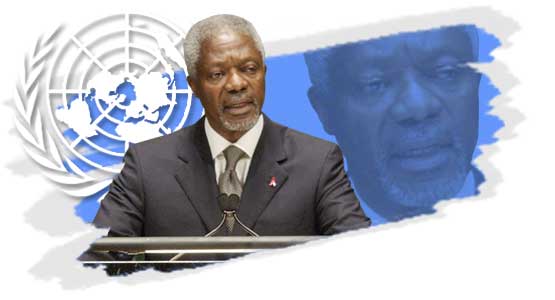
Kofi Annan, the then UN General Secretary
remarked in 2002: "While sustainable
development may be the new conventional wisdom, many people have still not
grasped its meaning." (Annan 2002)
|
|
Definitions
In 1983 the United Nations started the World Commission for
Environment and Development (WCED), which was given the task to deliver a study
on the long-term perspectives of World development up to the year 2000 and
beyond.
Under the leadership of the then Prime Minister of Norway, Mrs. Gro
Harlem Brundlandt, the commission delivered in 1987 the paper "Our Common
Future", better known as the "Brundlandt Report".
This report triggered the
development which led to:
|
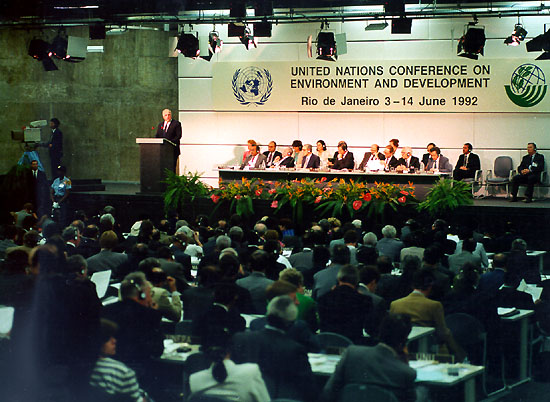
the 1992 United Nations conference on Environment and
Development in Rio de Janeiro
|
|
|
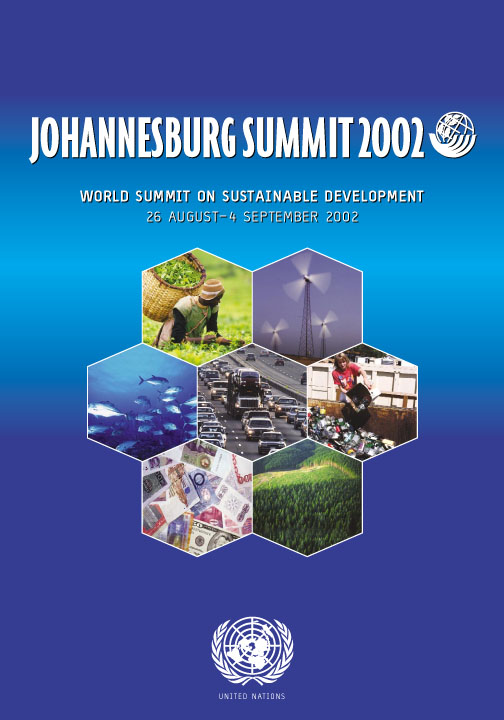
and the United Nations World summit on
Sustainable Development 2002 in Johannesburg
|
|
.
It also started the career of the term "Sustainability",
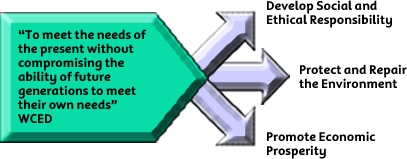
whereby Sustainable Development was defined as "Development that meets the needs of the present without
compromising the ability of future generations to meet their own needs."
(WCED 1987)
Ambiguities
With popularity and
over-usage however, the term developed many ambiguities, especially in
international institutions as it had been “appropriated to support the full
spectrum of development agendas”. (Doorne 2001)
This ambiguities can be divided into:
- different
languages and their different cultural approaches to the idea of
Sustainability
- Scope of usage of
Sustainability and
- the
Socio-political contest of the discourse on Sustainability in tourism
Different languages and their different cultural approaches to the idea
of Sustainability
Different languages transport different ideas about
"Sustainability":
For the English
language the Merriam-Webster Dictionary tells us:
|
sus·tain·abil·i·ty [s&s-'stA-n&-'bi-l&-tE] noun
1: capability of being sustained; 2a: of, relating to, or being a method of
harvesting or using a resource so that the resource is not depleted or
permanently damaged <sustainable techniques> <sustainable agriculture> b: of or relating to a lifestyle involving the use
of sustainable methods <sustainable society>
circa 1727 Merriam-Webster |
To sustain is an active process of keeping something alive,
Sustainability here is a situation which is favorable for the action of
sustaining, with no explicit reference to time.
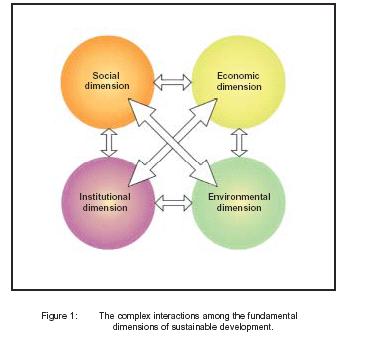
An organisation in Colorado/USA therefore shortened the imperatives of
Sustainable Development to the catchphrase “People, Planet, Profit”. (3P
Colorado)
This misses however
the fourth dimension connected to Sustainable Development: Institutions
In German the idea is very different and – unsurprisingly – based on the
beloved German concept of a Perfect machine:
|
 |
The German term
used for Sustainability - "Nachhaltigkeit" is based on the idea of
a carefully crafted perfect system, which once in place, does not need any
outside action anymore. "Nachhaltigkeit" actually originates from forestry and was coined in
1713 by the mining official Hans Carl von
Carlowitz in the silver-mine town of
Freiberg (Saxony). Because of lack of wood needed for the mines he developed the
concept that only so many trees should be cut down as would regrow to keep the
supply stable. |
In French the temporal dimension is stressed: Long-time
existence.
"Durabilité" therefore concentrates on the fact that something can exist
for a long time and is not easy to destroy. Plastic for instance is very
durable.
Other European languages, like Polish, Finnish and many others have no noun for
Sustainability at all, they use something similar to "long-time development",
but normally just take the English term for granted.
Chinese has a
complex meaning on offer: Existence and Movement
"Ke Chi Xu" 可持续
combines "possibility", "existence" and "not stopping over a long period of
time" to a multi-dimensional term.
Each term is based
on the relevant worldview and outlook of different countries, most of the time
without realising that in other languages the connotations might be quite
different, leaving to endless misunderstandings in multicultural
projects.
Scope of usage of Sustainability
Beside
socio-semantical trap-doors, the scope of the concept of Sustainability also
differs widely. Biocentric and anthropocentric approaches clash, and the famous
sustainability triangle has been further developed.
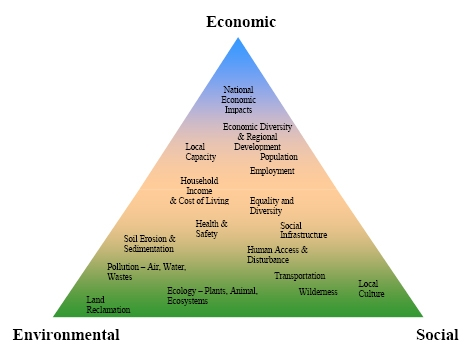
From the triangle
- ecological meaningful modernisation
- economical meaningful
modernisation
- social justice and participation
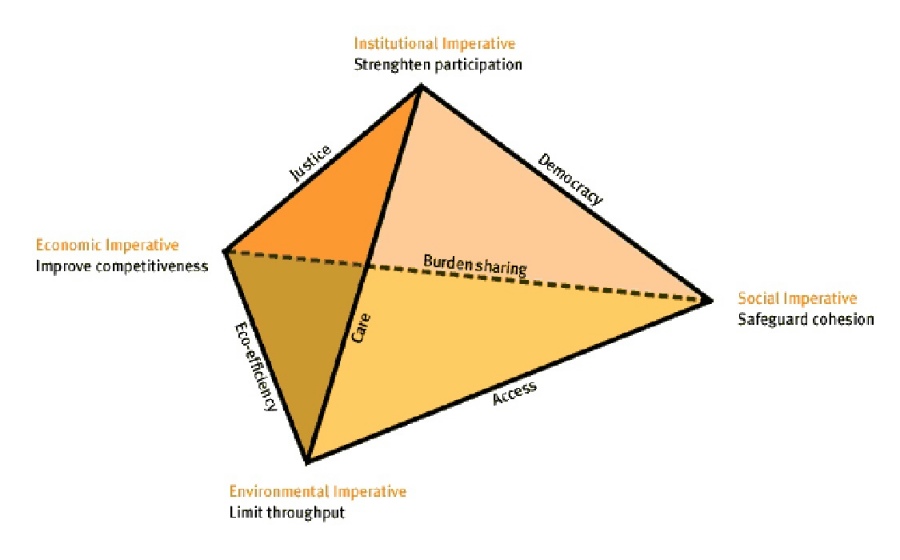
Spangenberg and
Bonniot developed a prism which includes institutions as well:
Socio-political contest of the discourse on Sustainability
in tourism
For the tourism sector, the World Tourism Organisation first
defined „Sustainable Tourism“ in 1988 – clearly in the footsteps of the
Brundtland Report – as follows:
|
“Sustainable tourism development meets the needs of present
tourists and host regions while protecting and enhancing opportunity for the
future. It is envisaged as leading to management of all resources in such a way
that economic, social, and aesthetic needs can be fulfilled while maintaining
cultural integrity, essential ecological processes, and biological diversity,
and life support systems.” (WTO-UNEP 2002) |
The WTO Committee on Sustainable Development of Tourism, at
its meeting in Thailand, March 2004, agreed to revise the WTO definition of
sustainable tourism. The purpose of this revision is to reflect better the
sustainability issues in tourism, in light of the results of the Johannesburg
Summit on Sustainable Development. The new conceptual definition places emphasis
on the balance between environmental, social and economic aspects of tourism,
the need to implement sustainability principles in all segments of tourism, and
it refers to global aims such as poverty alleviation.
“Conceptual Definition” of Sustainable Development of
Tourism:
|
“Sustainable tourism development guidelines and management
practices are applicable to all forms of tourism in all types of destinations,
including mass tourism and the various niche tourism segments. Sustainability
principles refer to the environmental, economic and socio-cultural aspects of
tourism development, and a suitable balance must be established between these
three dimensions to guarantee its long-term sustainability.
Thus, sustainable tourism should:
Make optimal use
of environmental resources that constitute a key element in tourism
development, maintaining essential ecological processes and helping to conserve
natural heritage and biodiversity.
Respect the
socio-cultural authenticity of host communities, conserve their built and
living cultural heritage and traditional values, and contribute to
inter-cultural understanding and tolerance.
Ensure viable,
long-term economic operations, providing socio-economic benefits to all
stakeholders that are fairly distributed, including stable employment and
income-earning opportunities and social services to host communities, and
contributing to poverty alleviation.
Sustainable tourism development requires the informed
participation of all relevant stakeholders, as well as strong political
leadership to ensure wide participation and consensus building. Achieving
sustainable tourism is a continuous process and it requires constant monitoring
of impacts, introducing the necessary preventive and/or corrective measures
whenever necessary.
Sustainable tourism should also maintain a high level of
tourist satisfaction and ensure a meaningful experience to the tourists,
raising their awareness about sustainability issues and promoting sustainable
tourism practices amongst them.” (WTO
2004) |
Looking at the
differences between the Pre-Rio and the Post-Johannesburg definition one cannot
fail to notice that parallel interests exists between the tourism
industry, the guests and the hosts to uphold environmental quality – because this
is what is sold, visited, and lived in.
No parallel
interests exists however in social and
cultural sustainability: The industry wants
sellable product (and therefore standardization, commodification), guests want
the fulfillment of their expectations. Both are not automatically interested in
the well-being of hosts, resulting in the perceived need for “strong political
leadership” and “corrective measures”.
Where these are
absent, very often host hostility is developing over time, with unfulfilled
promises of development letting local turn to short-term profitmaking that also
endangers their own nature and economy.
Even more important
than the differences in language and scope is the fact that
“Sustainability”
is “.. used by a variety of interests in a variety of ways as a means of
supporting and enhancing their power base”. (Duim/Caalders
2004)
“Sustainable
development of tourism is” – Duim/Caalders conclude – “a contested concept that
is socially constructed and reflexts the interests of those
involved.”
For example:
US President's Council on
Sustainable Development:
"Sustainable development is economic growth that will
benefit present and future generations without detrimentally affecting the
resources or biological systems of the planet. A sustainable
United States will have a growing economy that provides equitable
opportunities for satisfying livelihoods and a safe, healthy, high quality of
life for current and future generations. Our nation will protect its
environment, its natural resource base, and the functions and viability of
natural systems on which all life depends."
Muscoe Martin, Author of: "A Sustainable Community Profile"
"The word
sustainable has roots in the Latin subtenir, meaning 'to hold up' or 'to support
from below.' A community must be supported from below - by its inhabitants,
present and future."
Richard Butler,
inventor of the "Tourism product cycle":
Sustainable tourism is "tourism which is in a form which can
maintain its viability in an area for an indefinite period of time".
Conclusion
For the development
of Sustainable Tourism it is necessary to pay atttention to all three sides of
the triangle: economic prosperity, careful use of natural and human resources
and civil society.
Sustainable development is first of all definition of goals,
objectives and criteria for measurement, and the instrumentalization of these
through governmental and non-governmental organizations. i.e. development of
policies.
When speaking about
Sustainability one has to be aware of linguistic and cultural differences of the
concepts behind, the differences in scope and the fact that different
definitions serve different interests
|